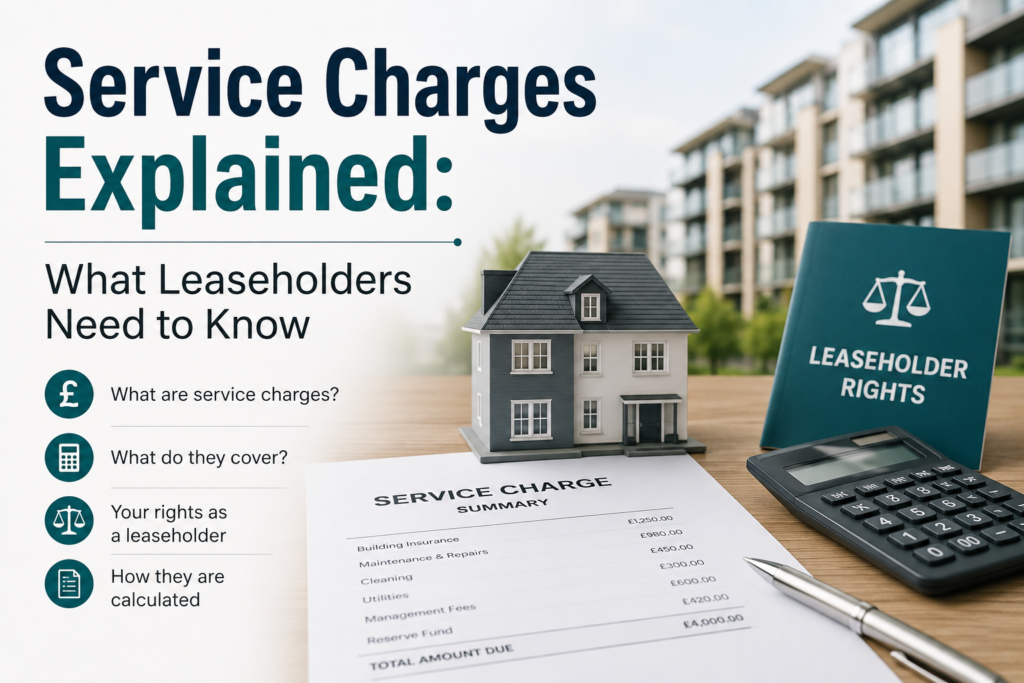
Service Charges Explained: What Leaseholders Need to Know
Service Charges is a topic every leaseholder should understand. If you’ve ever received an annual service charge bill and wondered exactly what you’re paying for, you’re not alone. It is one of the most misunderstood aspects of leasehold property ownership. While they are essential for maintaining residential developments, many leaseholders are unsure how they are calculated, what they cover, and what rights they have if they disagree with the costs.
Understanding this can help you budget more effectively, identify legitimate expenses and ensure your building is managed professionally. Whether you own a flat in a small converted property or a large purpose-built development, knowing how leaseholder charges work is an important part of being a leaseholder.
If you have questions about your building’s service charges or are looking for a more transparent managing agent, Your Home Property Management is here to help. Contact our team today or book a free consultation to discuss your property.
What Are Service Charges?
Service charges are payments made by leaseholders to cover the cost of managing, maintaining and repairing the communal areas of a residential building.
Unlike mortgage payments or ground rent, these charges are used to fund the day-to-day operation of the development. These charges help ensure shared spaces remain safe, clean and well-maintained while meeting legal and regulatory requirements. Every lease outlines which costs can be recovered, making it important for leaseholders to understand the terms of their lease agreement.
What Do Service Charges Cover?
Although every building is different, charges commonly contribute towards a range of essential services These may include:
- Cleaning of communal areas
- Gardening and landscaping
- Lift servicing and maintenance
- Building insurance
- Fire safety inspections
- Health and safety compliance
- Electrical testing
- Repairs to communal areas
- Roof maintenance
- External decorating
- Window cleaning
- Pest control
- Waste management
- Security systems
- Managing agent fees
- Professional accountancy services
- Reserve fund contributions
The exact items included depend on the lease and the requirements of the building.
How Are Service Charges Calculated?
There is no standard service charge for every building. Instead, costs are based on the annual budget required to operate and maintain the development. Several factors influence the overall amount, including:
1. Size of the Building
Larger developments generally require higher maintenance budgets due to additional communal facilities and infrastructure.
2. Shared Facilities
Buildings with lifts, underground parking, gyms, concierge services or landscaped gardens usually incur higher service charge costs.
3. Building Age
Older properties often require more frequent repairs and preventative maintenance.
4. Planned Maintenance
Major works, such as roof replacements or external decorations, can significantly affect annual budgets.
5. Compliance Requirements
Regular fire risk assessments, asbestos management, electrical inspections and other statutory obligations also contribute to service charge costs.
Typical Service Charge Budget
A service charge budget is prepared before the start of each financial year and estimates the expected costs of running the building.A typical budget may include:
| Expense | Purpose |
| Cleaning | Communal area cleaning |
| Gardening | Landscape maintenance |
| Insurance | Building insurance |
| Repairs | Routine maintenance |
| Compliance | Fire and safety inspections |
| Utilities | Communal electricity and water |
| Managing Agent | Property management services |
| Reserve Fund | Future major works |
Professional managing agents regularly review budgets to ensure they remain realistic and reflect the building’s requirements.
Looking for clearer financial reporting and transparent service charge management? Your Home Property Management provides professional budgeting, financial administration and property management services tailored to residential developments. Contact us today to arrange a consultation.
What Is a Reserve Fund?
A reserve fund, sometimes called a sinking fund, is money collected over time to pay for future major works. Instead of asking leaseholders to contribute a large one-off payment when expensive repairs are required, contributions are collected gradually each year.
Reserve funds are commonly used for:
- Roof replacement
- Lift replacement
- External redecorations
- Structural repairs
- Window replacement
- Major mechanical upgrades
Having a healthy reserve fund helps reduce unexpected financial pressure on leaseholders.
Can Charges Increase?
Yes. Charges can increase from year to year depending on the needs of the building. Common reasons include:
- Inflation
- Rising contractor costs
- Increased insurance premiums
- Additional compliance requirements
- Planned maintenance projects
- Emergency repairs
- Utility price increases
An increase doesn’t necessarily indicate poor management. In many cases, it reflects the genuine costs of maintaining the building safely and effectively.
What Rights Do Leaseholders Have?
Leaseholders have important legal rights . These include the right to:
- Receive a summary of service charge accounts
- Request supporting invoices and receipts
- Challenge unreasonable charges
- Be consulted on qualifying major works
- Understand how charges are calculated
- Ask questions about annual budgets
- Receive information in accordance with leasehold legislation
Transparency is an essential part of effective property management.
What Happens if Service Charges Are Not Paid?
Service charges fund the ongoing maintenance of the building, so non-payment can create financial difficulties for the entire development. If charges remain unpaid, managing agents or freeholders may:
- Issue reminder notices
- Charge interest where permitted
- Begin debt recovery procedures
- Take legal action where necessary
Paying on time helps ensure contractors, maintenance programmes and essential services continue without disruption.
How Can Managing Agents Help Control Costs?
An experienced managing agent doesn’t simply collect fees. They also help deliver value by:
Obtaining Competitive Contractor Quotes
Professional procurement helps ensure residents receive competitive pricing for maintenance and repairs.
Planning Preventative Maintenance
Addressing issues early often prevents expensive emergency repairs.
Managing Reserve Funds
Long-term financial planning reduces the likelihood of unexpected major bills.
Providing Financial Transparency
Regular reporting allows leaseholders to understand exactly how money is being spent.
Monitoring Contractors
Ensuring work is completed to a high standard helps avoid unnecessary repeat repairs.
How to Review Your Annual Service Charge Statement?
When reviewing your annual statement, consider the following:
- Compare this year’s costs with previous years.
- Check whether major repairs were completed.
- Review reserve fund balances.
- Ensure contractor costs appear reasonable.
- Ask for clarification if any charges are unclear.
- Understand future planned maintenance.
Being informed helps leaseholders make better decisions about the management of their building.
Final Thoughts
Service charges play an essential role in maintaining safe, attractive and well-managed residential developments. Understanding what they cover, how they are calculated and the rights available to leaseholders can help you make informed decisions about your property and ensure you’re receiving value for money.
A professional managing agent should provide clear budgets, transparent reporting and proactive financial management while keeping residents informed throughout the year.
If you’re looking for a managing agent that prioritises transparency, accountability and excellent customer service, Your Home Property Management can help you manage your building with confidence.
Frequently Asked Questions
Service charges are payments made by leaseholders to cover the cost of maintaining, repairing and managing communal areas within a residential development.
No. Ground rent is a payment made to the freeholder, while service charges pay for the ongoing management and maintenance of the building.
Service charges may include cleaning, insurance, repairs, gardening, lift maintenance, fire safety compliance, managing agent fees, utilities and reserve fund contributions.
Yes. Leaseholders have the right to challenge service charges if they believe they are unreasonable or not permitted under the lease.
Service charges may increase because of inflation, rising maintenance costs, insurance premiums, major works or additional compliance requirements.
A reserve fund is money collected over time to pay for future major repairs and improvements, helping to avoid large one-off bills for leaseholders.
About The Author
James Cooke has more than 25 years’ experience in residential property management and is the sole director of YHPM Ltd. He is an Associate Member of the Royal Institution of Chartered Surveyors (AssocRICS).
YHPM Ltd is registered with the Information Commissioner’s Office (ICO) and is a member of The Property Institute, The Property Ombudsman, and the Chartered Institute of Housing, demonstrating its commitment to professional standards, regulatory compliance and customer service.
James Cooke MA AssocRICS CIOH
James Cooke
The Your Home Property Management Team is led by James Cooke MA AssocRICS MCIH. James has over fifteen years experience as a property management professional with a track record of delivering outstanding services to customers. He has worked at some of the biggest landlords in the UK, delivering services to thousands of homes.
James has been a leaseholder, and still owns leasehold property. James’s commitment to delivering truly outstanding customer service means he is well placed to manage operations at Your Home Property Management.

Luke Gymer-Nicholas
Hi, I am Luke Gymer-Nicholas – Having spent over 18 years working in the retail sector, holding many different roles at the beginning of 2020 I made the decision to take some time out. I wanted to put my skills I had learnt over the years into another sector and try something new and in July 2020 I joined the team at YHPM.
Having the opportunity to work at YHPM means I can put my extensive customer service experience to good use. Customer service has always been at the forefront of every role I have held over the years, and this continues to be the case.
I am really happy to be part of the team at YHPM and look forward to working with you all in the future.

Prity Amin
Hi, my name is Prity Amin. My journey is a little different to my colleagues! I was born in the beautiful islands of Fiji, I spent my childhood in Fiji before moving to New Zealand in 1990 to continue with my secondary and tertiary education. I qualified with a Diploma in Business Studies in 1997. I started my professional career working as an Accounts Payable officer at the renowned airline – Air New Zealand at their head office in Auckland, New Zealand.
In 1999, I yet again moved, I moved to UK and now call it home. I am based in Essex.
It’s an absolute pleasure to be part of the very professional YHPM team.

Sian White
Hi, I am Sian White, I just joined the team at Your Home Property Management in June 2021. I have been in property for the last 20 years doing a variety of roles from selling to letting, now I’m learning new skills through block management and can also build on my extensive customer service experience.
I have always lived in Kent and that’s where the majority of my property expertise comes from, and now is a chance to branch out further afield with Your Home Property Management.

Samantha Stiles
Hi, my name is Samantha Stiles. I joined the Your Home Property Management team in January 2022. I am new to property management but excited to be expanding my knowledge and skills in a different field focusing on supplying great customer service to our clients. I have 16 years experience in customer service with 13 years of that working within healthcare requiring quick response times and accurate reporting. I will bring this experience with me to support the growing team at YHPM and look forward to working with you.
Lee White
Hi, I’m Lee. I have been the property inspector at YHPM since September 2021. I go to all the blocks that we manage on a monthly or quarterly basis and report back to the assigned property manager at YHPM, they will then pick up any issues and deal with them. I am enjoying my time working with the team at YHPM, I have learnt new skills and built on my knowledge of property management.
My previous experience is within the security industry so I bring my knowledge of health & safety along with security with me to this position.